In the last post I introduced the purpose of this blog and the mission that I’m on: To find out if it’s possible to beat the odds and earn money on sports betting by using math.
Getting started seems like a big task. I have to somehow gather a lot of data, analyze it, create a model, set up an automatized betting system, monitor it, and so on. Let’s start with something easier: What happens if we just bet randomly? Exactly how much money do we lose then?
So why is this at all interesting? This will serve as a baseline, that we can use to compare with other games such as roulette or black jack, where the house always wins. Take roulette as an example, and imagine that you bet 1\$ on black. If it lands on black you will take back the original 1\$ and another 1\$, and if it lands on red or 0 you will lose that money. On a roulette wheel there is usually between one and three of the 0 fields (called 0, 00 and 000), let’s say that there are two on this wheel. Then you will win with probability 18/38 and lose with probability 20/38. If you run the numbers, this means that per dollar you spend you’ll on average get back (in dollars):
$$\frac{18}{38} \cdot 2 \approx 0.95$$
This means that a very similar game could be the following: You start by paying the house 0.05\$ and after that you do a fair coin toss where you bet 1\$.
When betting on football (or anything else for that matter) there is a similar pattern. Say that the odds you get for a specific football match are:
$$r_H, r_D, r_A$$
for a home win, draw and an away win respectively, and the probability that these events occur are:
$$p_H, p_D, p_A$$
Now say that you randomly pick which outcome (home win, draw, away win) to bet for and that you choose those with probabilities:
$$q_H, q_D, q_A$$
Your expected return will then be:
$$r_H \cdot p_H \cdot q_H + r_D \cdot p_D \cdot q_D + r_A \cdot p_A \cdot q_A$$
We do not know the underlying probabilities, $p_i$, (if we did it would be extremely easy to bet), but we can still determine how much we pay just to bet – similar to the 5% we would pay to play roulette. Define $q_H$ by
$$q_H = \frac{\frac{1}{r_H}}{\frac{1}{r_H} + \frac{1}{r_D} + \frac{1}{r_A}}$$
and $q_D,q_A$ similarly, then it’s clear that
$$q_H + q_D + q_A = 1$$
and the expected return is then:
$$\frac{p_H + p_D + p_A}{\frac{1}{r_H} + \frac{1}{r_D} + \frac{1}{r_A}}$$
and since
$$p_H + p_D + p_A = 1$$
this is just
$$\frac{1}{\frac{1}{r_H} + \frac{1}{r_D} + \frac{1}{r_A}}$$
We can use this value to determine how much we actually need to pay in order to play. This will give us an indication of how good the odds actually are. On betfair you pay a percentage of your winnings, so there’s a separate concern there, but for now let’s simplify and ignore that factor.
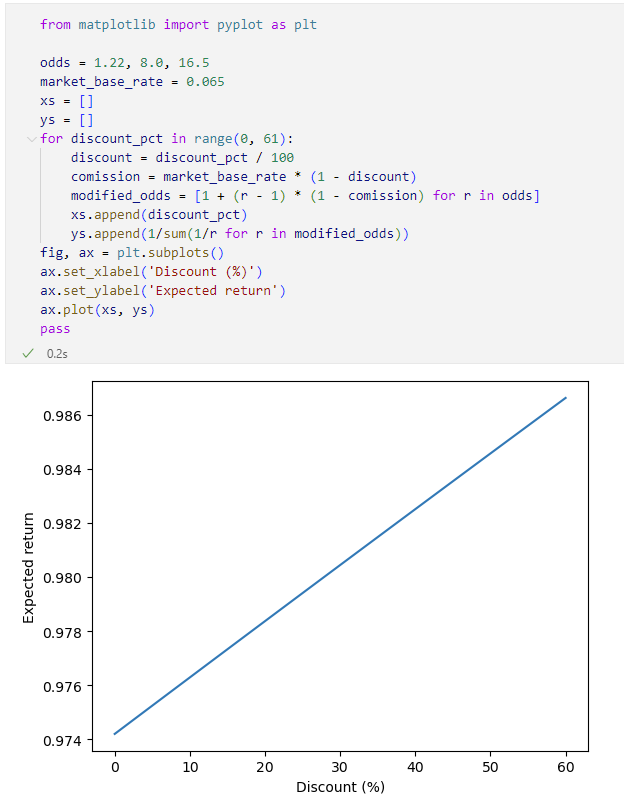
Let’s take an example. Tonight Man City plays West Ham. The odds I see right now are: 1.22 for Home win, 8.0 for Draw, 16.5 for Away win. This translates into an expected value for a random bet at:
$$\frac{1}{\frac{1}{1.22} + \frac{1}{8.0} + \frac{1}{16.5}}$$
which is roughly $0.995$.
This means that we don’t pay a lot in order to play. But we haven’t taken commisions into account. As their comission, Betfair takes 6.5% of your winnings (if you live in Denmark). Taking this into account the odds of 1.22 turns out to only be effectively 1.2057, and if we do the updated calculation we receive roughly $0.974$. As you bet more, you can get a discount on these 6.5% (called the market base rate) of up to 60%. The plot below shows how this would impact the expected return of random betting (for this particular market).

Leave a Reply to Ian McKellen Cancel reply